Mercedes-Benz W108 buyer's guide
The classic Paul Bracq S-Class sedan — the heart of this collection.
Years: 1965–1972 · Models: 250S, 250SE, 280S, 280SE, 280SEL, and the 280SE 3.5 and 280SEL 4.5 V8s
Overview and history
The W108 is the car that set the template for every Mercedes-Benz S-Class that followed — built before Mercedes used the S-Class name, but recognisably the same idea: a big, formal, six- or eight-cylinder sedan engineered a clear step above everything else on the road. It replaced the "fintail" W111 and W112 sedans and was shown for the first time at the Frankfurt motor show in September 1965. Production ran from September 1965 to November 1972 in Europe, with the last cars sold in North America as 1973 models.
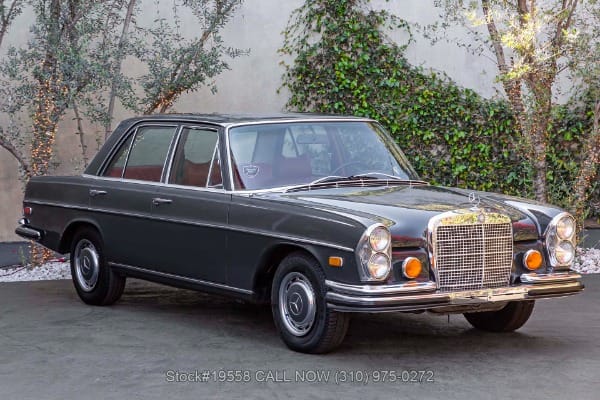
The styling was led by Paul Bracq, working with Friedrich Geiger, and it was a deliberate break with the fins and chrome of the fintails: a lower beltline, a much larger glasshouse, clean flanks and stacked headlight units. Underneath, the W108 kept the fintail platform's architecture — double-wishbone front suspension, a low-pivot swing axle at the rear, four-wheel disc brakes and Béla Barényi's safety-cell body.
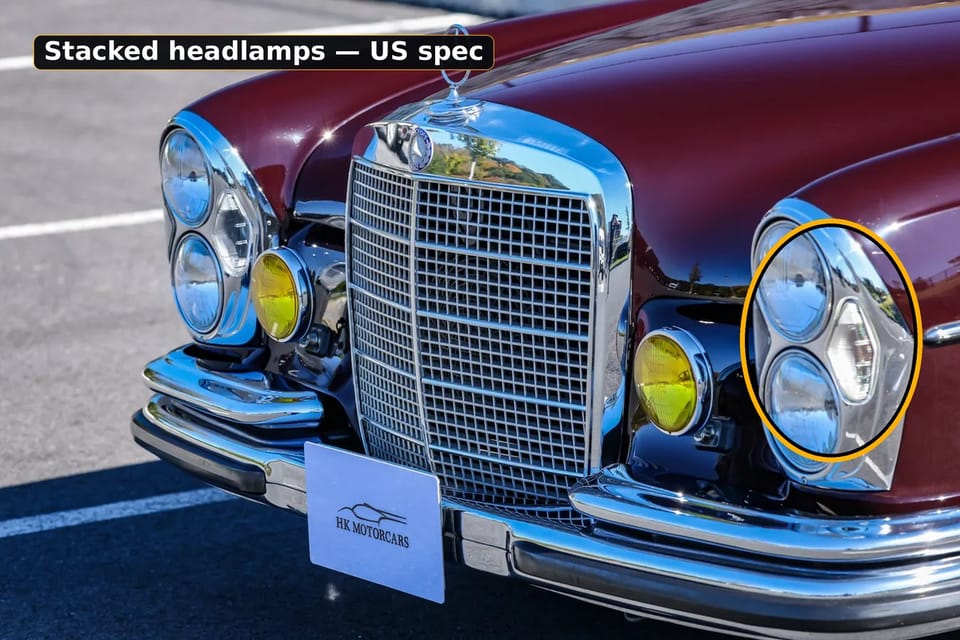
In total, 383,072 W108 and W109 sedans were built, about 360,000 of them wearing the W108 badge. The W109 was the long-wheelbase, air-suspended 300SEL line, covered by its own guide; everything here is the steel-sprung W108. North America was a major market — why so many cars in our listings are US models, and why the US-only 4.5-litre V8 exists at all.
These were expensive cars that were maintained properly for the first half of their lives and then, as values fell in the 1980s and 1990s, often run on a budget or parked. That history defines today's market: the mechanicals are fundamentally tough, and the difference between a good W108 and a money pit is almost entirely rust and deferred maintenance, not mileage.
The models
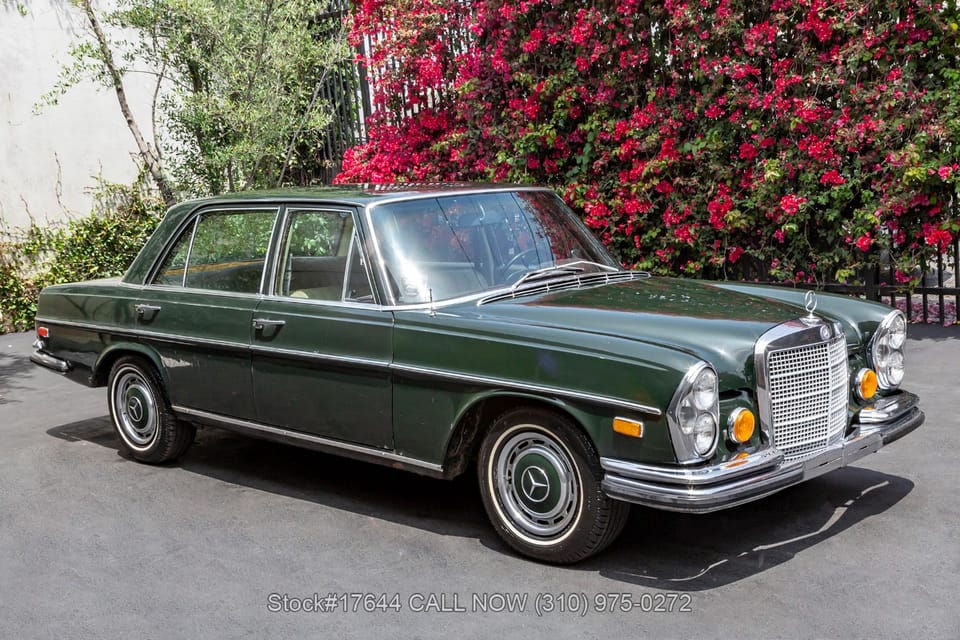
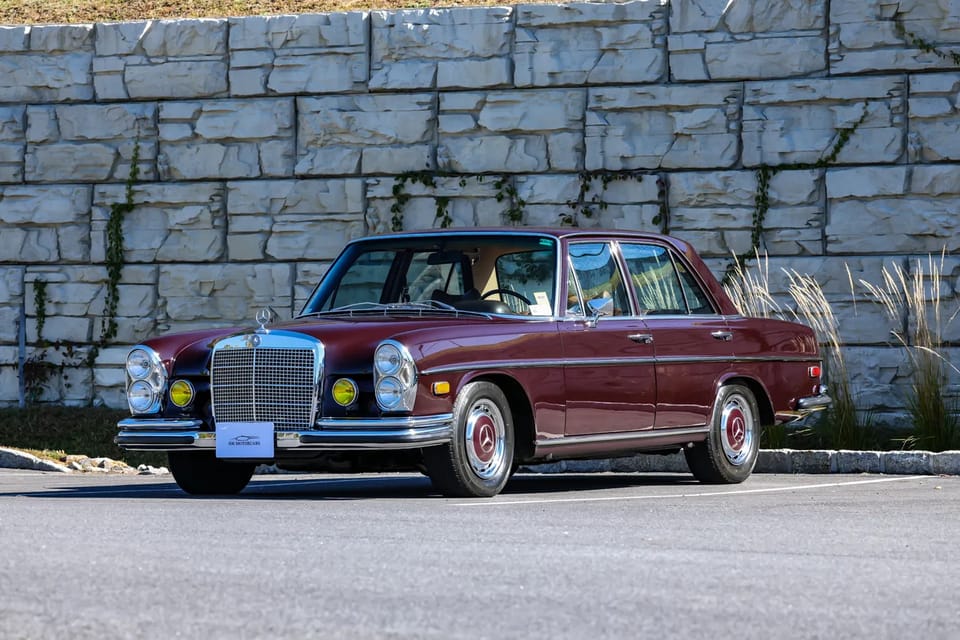
Every W108 is a four-door sedan. The badge tells you the engine and the trim level: S cars have carburettors, SE cars are fuel-injected, and SEL adds 100 mm (about 4 inches) to the wheelbase, all of it in the rear doors. The range started with the 2.5-litre sixes, was re-engined with the 2.8 in 1968, and finished with a pair of V8s that transformed the car's character.
| Model | Years | Engine | Output | Built | Character |
|---|---|---|---|---|---|
| 250S | 1965–1969 | 2.5 six (M108), twin carbs | 130 hp | 74,677 | The entry point; simple, slower, cheapest to buy |
| 250SE | 1965–1968 | 2.5 six (M129), injection | 150 hp | 55,181 | The better early car — injected and quicker |
| 300SE | 1965–1967 | 3.0 six (M189), injection | 170 hp | 2,737 | Rare flagship six; alloy engine, walnut trim |
| 280S | 1968–1972 | 2.8 six (M130), twin carbs | 140 hp | 93,666 | The value pick; carburettor quirks included |
| 280SE | 1968–1972 | 2.8 six (M130), injection | 160 hp | 91,051 | The core of the market and the default choice |
| 280SEL | 1968–1971 | 2.8 six (M130), injection | 160 hp | about 8,250 | Long wheelbase; rear legroom, rarer than the SE |
| 280SE 3.5 | 1971–1972 | 3.5 V8 (M116), injection | 197 hp | 11,309 | The connoisseur's car; the collector flagship |
| 280SE 4.5 | 1971–1972 | 4.5 V8 (M117), injection | 195 hp | 13,527 | US-market V8; effortless torque, 3-speed auto |
(Outputs are the period DIN figures for European cars, except the US-market 4.5, rated at 195 hp net. A 280SEL 3.5 and 280SEL 4.5 also exist — 951 and 8,173 built — and behave like their short-wheelbase sisters with more rear legroom.)
The sixes. The 250S and 250SE (1965–68) are the early cars, with slimmer bumpers and the original dashboard; the injected 250SE is the one to have — 20 hp stronger and free of the carburettor problems described below. The 280S and 280SE that replaced them in 1968 are the most numerous W108s of all — over 184,000 built between them — and the 280SE is the car most buyers end up with: quick enough to use anywhere, with the best parts support in the range.
The 300SE (1965–67) is the rarest W108 by a wide margin — just 2,737 built. Its M189 engine is an alloy-block six from the 300 "Adenauer" line, and the cabin got burled walnut where lesser cars have plainer wood. One myth to bury: the W108 300SE does not have air suspension. It rides on steel springs like every other W108; air suspension was reserved for the long-wheelbase W109 300SEL.
The V8s. The 280SE 3.5 (1971–72) put Mercedes' new M116 V8 into the sedan and made it a genuine 130 mph car: a European-spec, high-compression engine, with a rarer SEL version alongside. The 4.5 was created for the United States — a longer-stroke, low-compression version of the same family, tuned for torque and emissions, and sold only in North America. On the road they feel completely different: the 3.5 likes to rev, the 4.5 pulls from idle. Collectors pay the big money for the 3.5, but plenty of experienced owners will tell you the 4.5 is the nicer car to live with. Because the premium rides on the badge, verify the engine, not the boot lid: the engine number is stamped on the block, and a 3.5's begins 116.980, a US 4.5's 117.98. A "3.5" carrying a 117 engine is a 4.5 or a swap, whatever the seller calls it — and the data card settles any argument.
Engines and gearboxes
The sixes: M108, M129 and M130
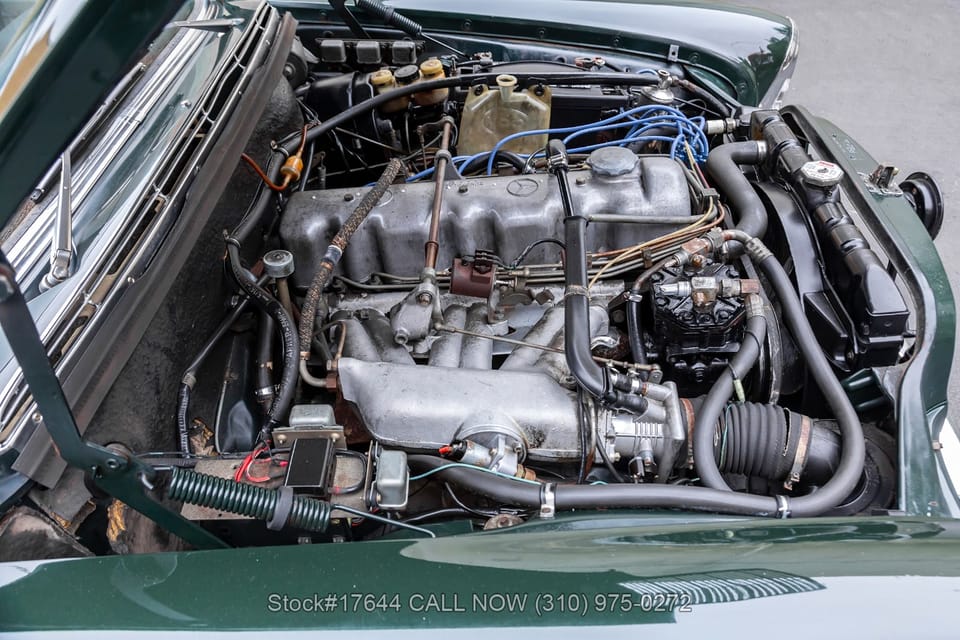
The 2.5- and 2.8-litre sixes are overhead-cam, chain-driven engines from one family, and famously long-lived if the oil has been changed. A healthy one starts easily, idles evenly, pulls cleanly and shows strong oil pressure — the gauge should sit high at speed and may drop at a hot idle, which is normal. A top-end rattle at start-up that fades in a second is usually the hydraulic tensioner filling; a rattle that stays is a worn chain or guides. Head gaskets typically last around 100,000 miles — oil in the coolant, or coolant in the oil, is the failure sign.
The real dividing line is how the fuel gets in.
Carburettors (250S, 280S). The S models use twin Zenith 35/40 INAT two-stage downdraft carburettors, and they sit directly on top of the exhaust manifold — which is the root of most of their reputation. Heat soak plus fifty years of uneven tightening warps the top covers, the joint faces leak air, and the result is a poor idle and flat spots that no amount of adjusting cures. But "warped Zeniths" is also the most over-used diagnosis on these cars. The second stage is not linked mechanically — it is opened by a vacuum diaphragm, and a split or hardened diaphragm gives poor acceleration and a car that will not pull to full speed, symptoms owners routinely blame on the carburettor bodies; the workshop test is simply whether the diaphragm holds vacuum. The mechanical fuel pump matters just as much: the Zeniths want roughly 2.5–3 psi, and an aged pump with a hardened diaphragm can push far more, overload the needle valves and dribble fuel at idle — flooding that looks exactly like a carburettor fault. The exhaust manifold's heat-riser flaps seize too, usually shut, which most specialists leave alone. Rule the vacuum leaks, the diaphragm and the fuel pressure in or out before paying for a rebuild — realistically $800–1,500 for the pair properly done — or accept that a cheap 280S with running problems may not be cheap for long.
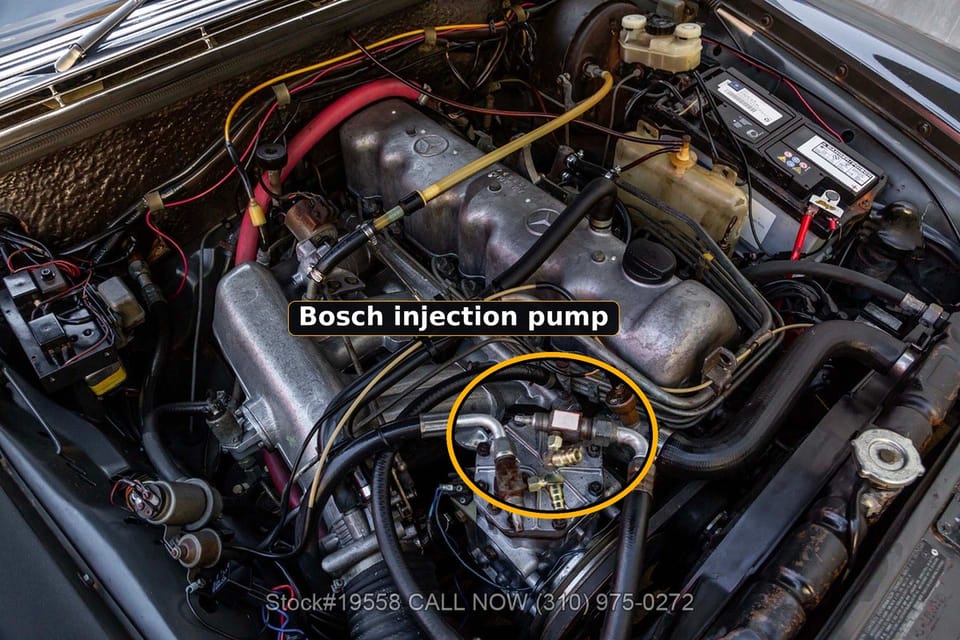
Mechanical injection (250SE, 280SE, 280SEL). The SE sixes use a Bosch six-plunger injection pump, driven from the engine, metering fuel mechanically against a three-dimensional space cam. When it's right, these cars start instantly, hot or cold, and run beautifully. When it's wrong, fault-finding needs a specialist: classic symptoms are hard hot starting and a rich, sooty idle. The wear that matters is plunger wear, and it announces itself as fuel dilution: petrol gets past the plungers into the oil. On pumps with their own oil reservoir, check the pump's own dipstick — the level rises between services and the oil reeks of fuel. On engine-oil-fed pumps the same leak shows on the engine dipstick: an oil level that creeps up instead of down, oil that feels thin and smells of petrol. Either way, a rising "oil" level is the tell, and it is a far more reliable test than how the car happens to run on the day. A pump rebuild from one of the handful of US specialists is roughly $2,000–3,500, so documented pump work is worth a premium. Two cheaper causes of a rich SE catch buyers out. The pump's wax-element thermostat fails with age and holds cold enrichment on when warm — and a stuck-open engine thermostat does the same thing, because an engine that never reaches temperature is an engine the pump correctly believes is still cold. Check the temperature gauge's story before condemning the pump.
The 300SE's M189 is a different animal: an alloy-block 3.0-litre with its own injection setup, developed from the 300 "Adenauer" six. Strong and characterful, but engine-specific parts are scarcer and dearer than for the iron-block sixes, and any M189 work is specialist territory.
The V8s: M116 3.5 and M117 4.5
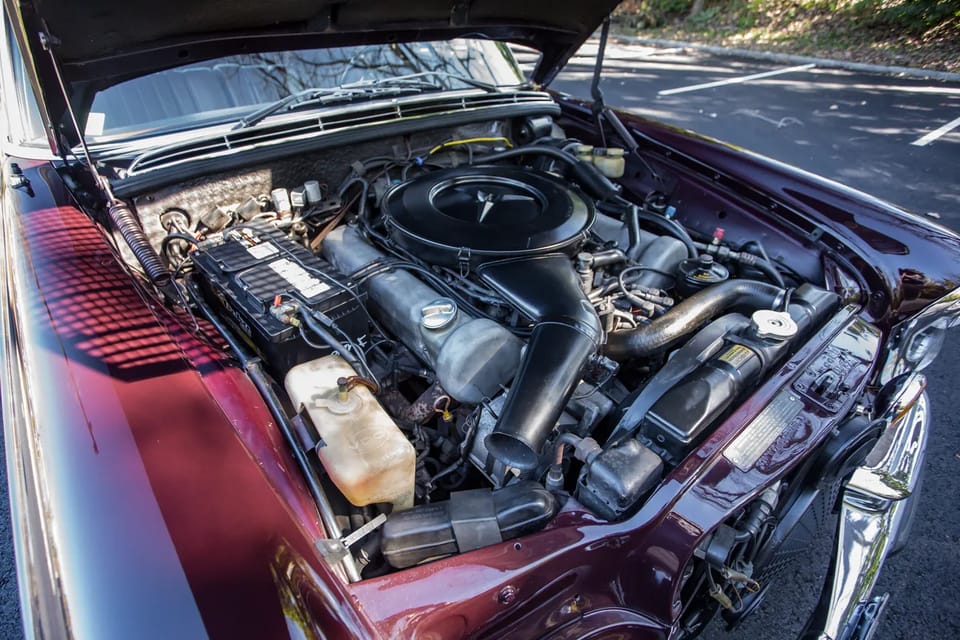
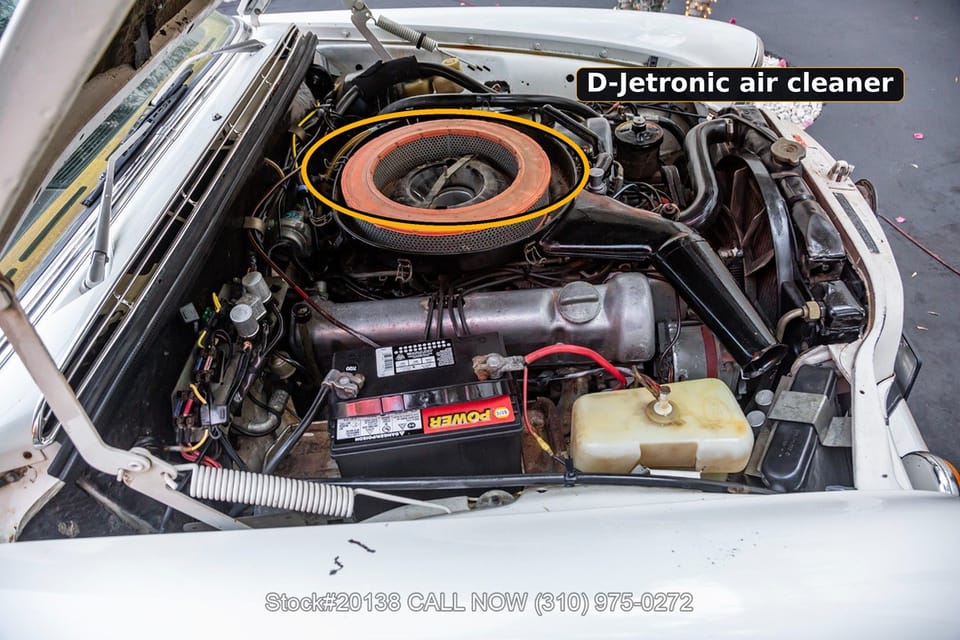
The small V8s are superb engines — alloy heads on an iron block, overhead cams, and Bosch D-Jetronic electronic injection. The 3.5 is a high-compression (9.5:1) European engine that wants premium fuel and revs eagerly to make its 197 hp. The 4.5 is the US answer: 8.0:1 compression, 195 hp in net terms, and a fat, lazy torque curve. Both should start on the button and pull hard without smoke. Blue smoke on the overrun points to valve stem seals (a known, fixable job); smoke under load is rings, and that is an engine-out conversation.
D-Jetronic is reliable but has period failure points, and the trigger points top the list — though not for the reason most people assume. They switch only tiny currents, so the contacts themselves rarely burn; what fails is mechanical. The fibre rubbing blocks that ride the cam in the base of the distributor wear down, which closes the points up and upsets the injection timing, and oil creeps up the distributor shaft and fouls the contacts. The classic presentation is a misfire or stagger from cold that clears as the engine warms and the oil works off — which is why a distributor-out clean belongs in the service history, and why a car that "has always done that when cold" is describing a known fault, not a character trait. Next is the manifold pressure sensor: its diaphragm eventually perforates and the mixture goes rich at exactly the loads where you want power. It is testable in minutes — the sensor must hold vacuum from a hand pump — so test it before letting anyone sell you an ECU. Fuel pressure comes before all of it: the system wants about 2 bar (28–30 psi) at the rail, and half the "electronic" faults on these cars are a tired pump or a clogged filter moving the pressure off spec. The wax-type auxiliary air valve sticks too, giving a high hot idle no adjustment will cure. Aim for a smoke-free car with a documented chain-and-guides service: on any of these V8s the plastic guides and tensioner are a service item around 100,000 miles, and a skipped one can turn a good engine into scrap. Ask for the invoice, or price the job in.
Gearboxes
Most W108s in the US are automatics, and there are three different ones. The sixes and the 3.5 use Mercedes' own four-speed automatic with a fluid coupling (K4A 025 in early cars, the smoother K4C 025 from May 1969; the 3.5 got the strengthened K4A 040). These boxes pull away in second gear by design — first comes only on full throttle or kickdown — so a second-gear start is correct behaviour, not slip. Changes should be firm and clean; flaring between gears or a long delay engaging reverse means a rebuild, roughly $3,000–5,500 at a specialist. The 4.5 is different again: a three-speed with a proper torque converter (W3A 040), the first torque-converter automatic Mercedes sold, and a strong, simple box.
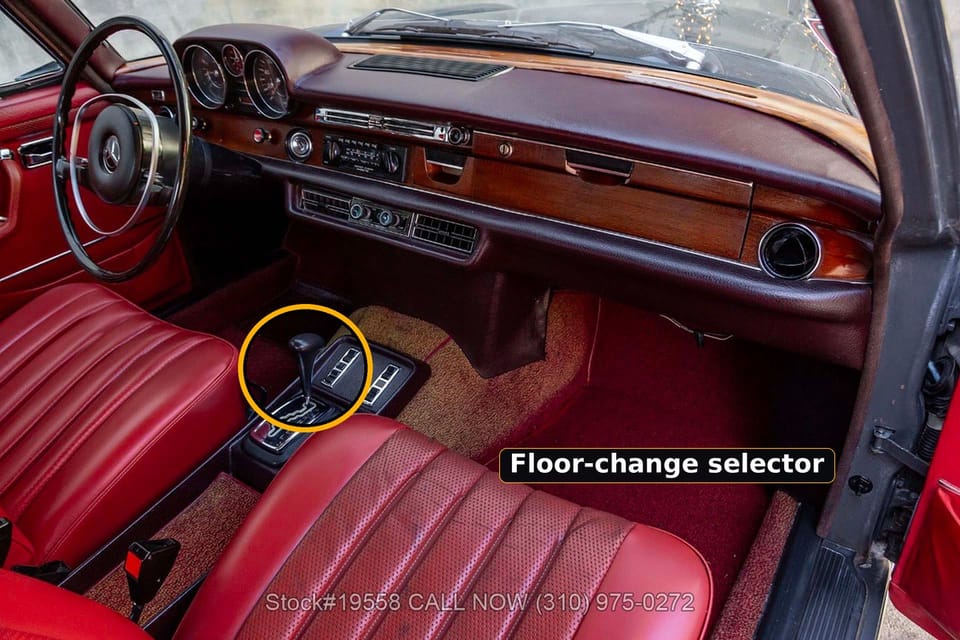
Manual cars — four speeds, column or floor change, plus a handful of five-speeds — are delightful but rare in the US, and as the cheaper cars when new they are often the most worn today. Judge them on synchromesh (second gear goes first) and clutch judder. On automatics the selector position is a trim choice, not a specification: the same boxes were sold with column and floor change, so never read the gearbox type off the shifter — the data card carries it.
Problem areas
Everything in this section is drawn from the cars themselves. We currently track 54 W108s for sale or recently sold in the US, and for 37 of them we have gone through the sellers' photo sets in detail. Rust appears somewhere in the photos of 26 of those 37 cars — seven in ten. Assume the body needs a forensic examination, and be pleasantly surprised when a car passes. Almost everything mechanical can be fixed with money and patience; structural rust is the one thing that reliably turns a bargain into a write-off.
Rust: the map
Rust on a W108 follows the water. Work through it in this order:
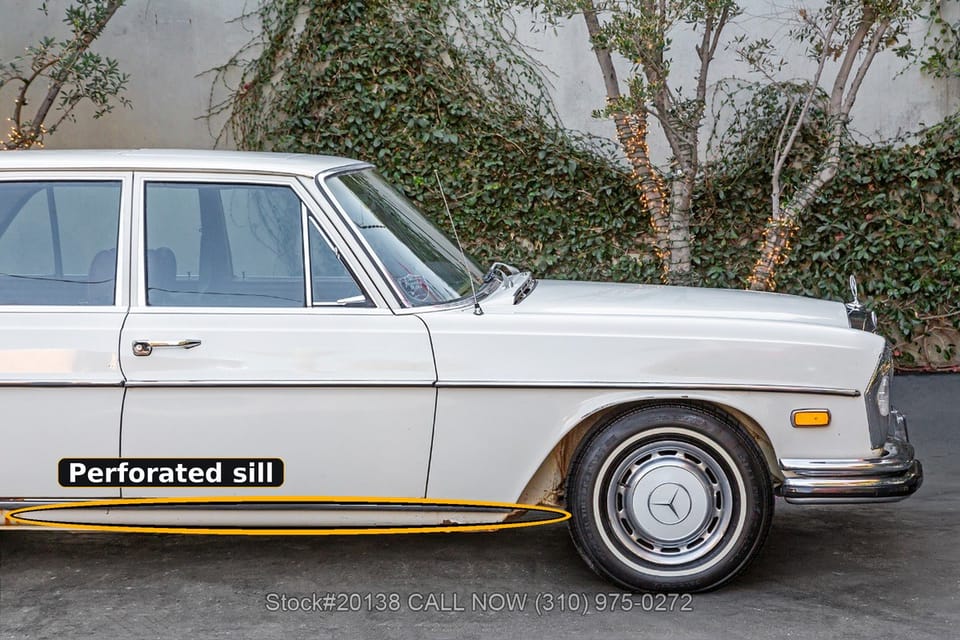
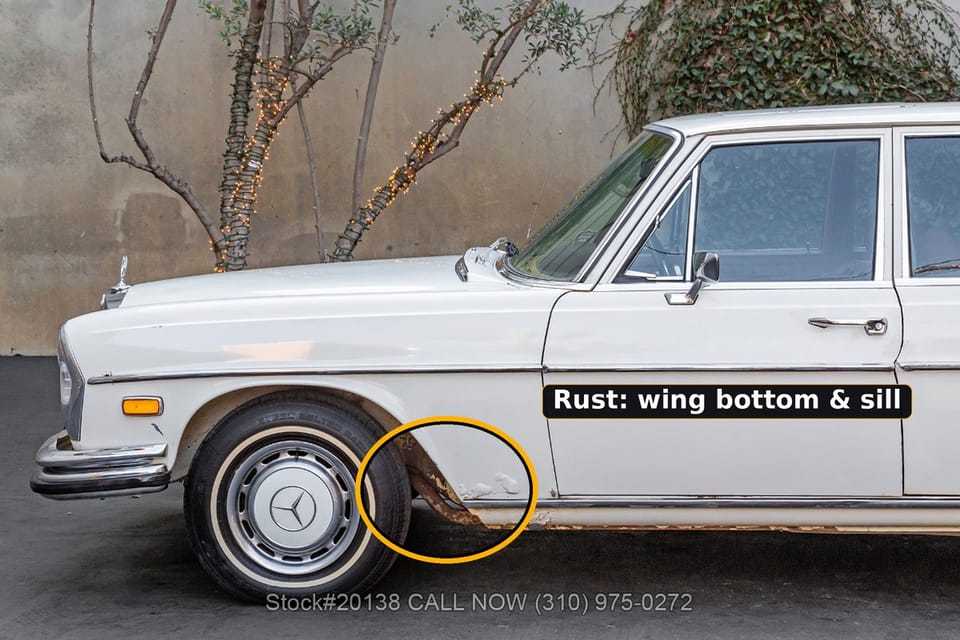
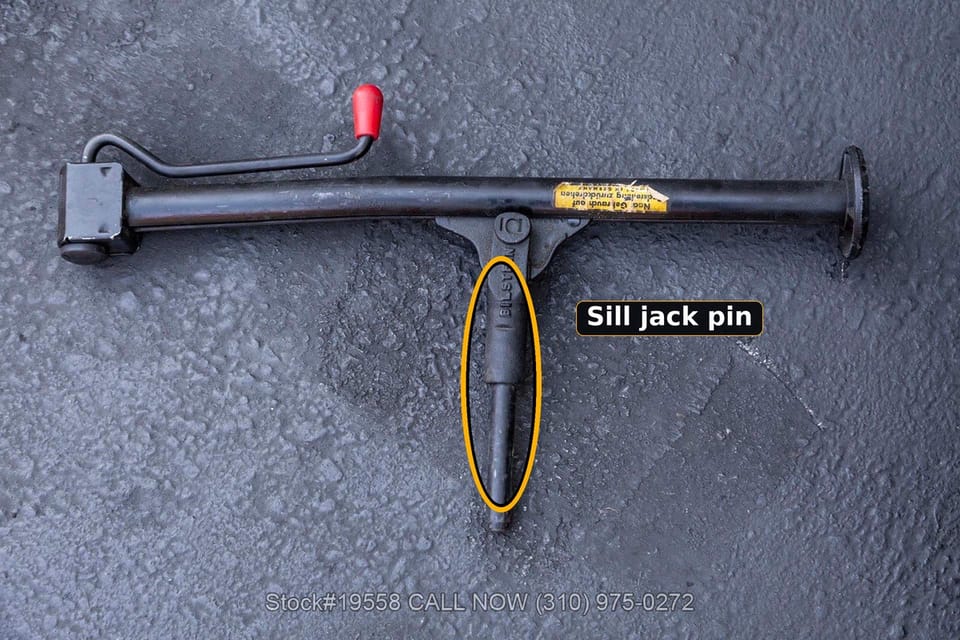
Sills and rocker panels. The single most important check. The sills are structural, trap mud and water thrown up by the front wheels, and rot from the inside out — by the time paint bubbles appear outside, the inside is usually worse. Press hard along the full length, check the jacking points, and be suspicious of fresh underseal or new sill covers. A sill cut out, welded and painted runs roughly $1,000–2,500 per side. The definitive test uses the car's own equipment: the factory jack plugs into a socket in each sill, behind a small cover. Take the car's weight on each socket in turn. A sound sill lifts the corner cleanly and silently; a rotten one creaks, flexes or starts to fold — and a seller who won't let you do it has answered the question.
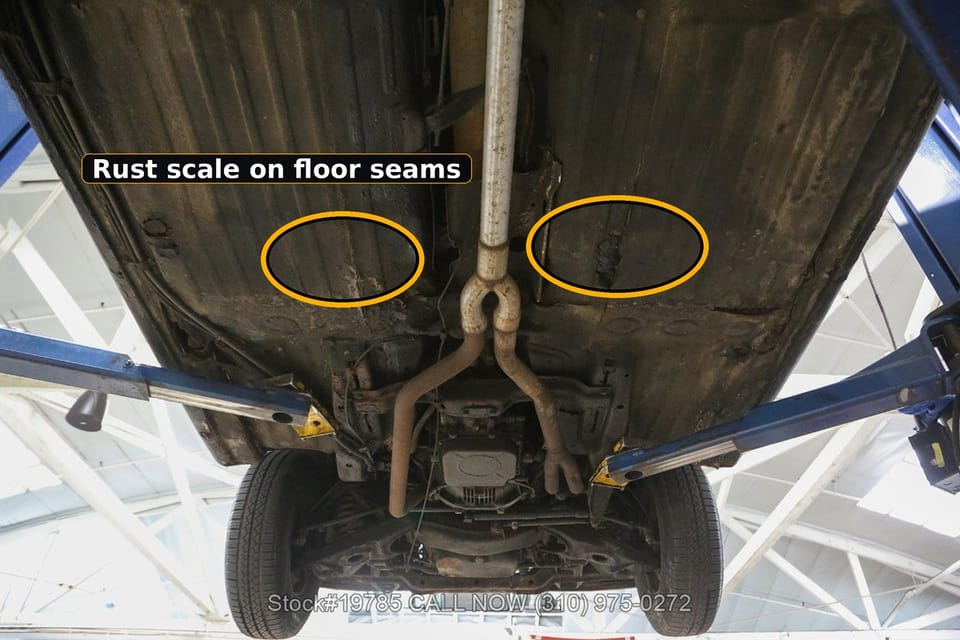
Floor pans. Water leaks past the windshield and rear window seals and the heater box, then sits under the carpets. Lift the carpets in all four footwells; surface rust is treatable, holes are not. Floor rust was plainly visible in 15 of the 37 cars in our photo sample. Repair sections are available at $500–1,500 a side fitted — but floors rarely rot alone, so treat floor rust as a marker for the whole shell.
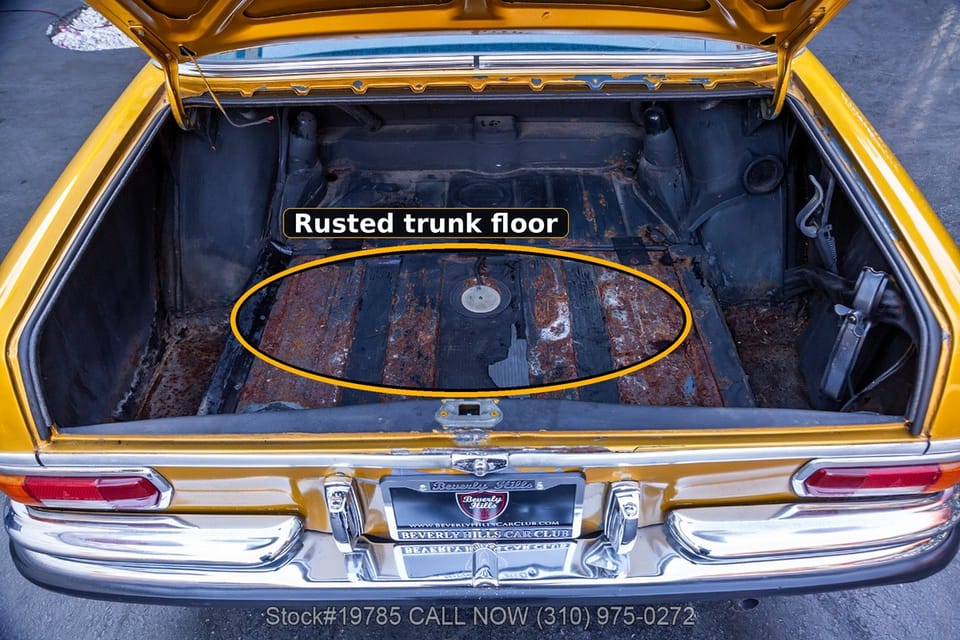
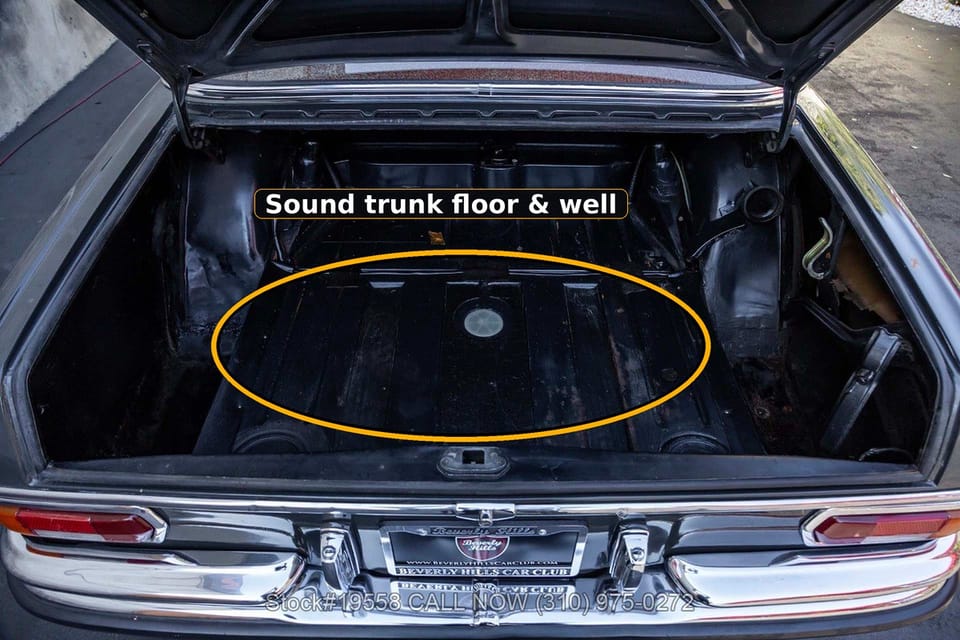
Trunk floor and spare wheel well. The rear window seal and the trunk seal leak, and the water collects exactly where you can't see it — under the spare wheel and in the corners of the well. Ten of our 37 photographed cars showed trunk rust, from staining to a floor you could see through. A rusted-out trunk floor is a panel replacement and paint ($800–2,000 done properly); staining is a clean-out, treat and seal job you can do yourself.
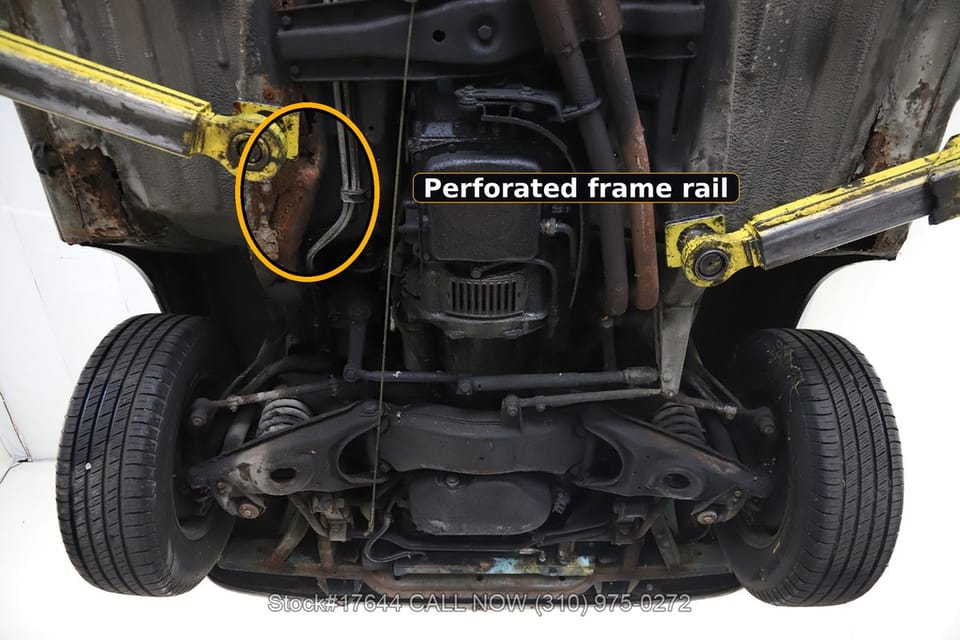
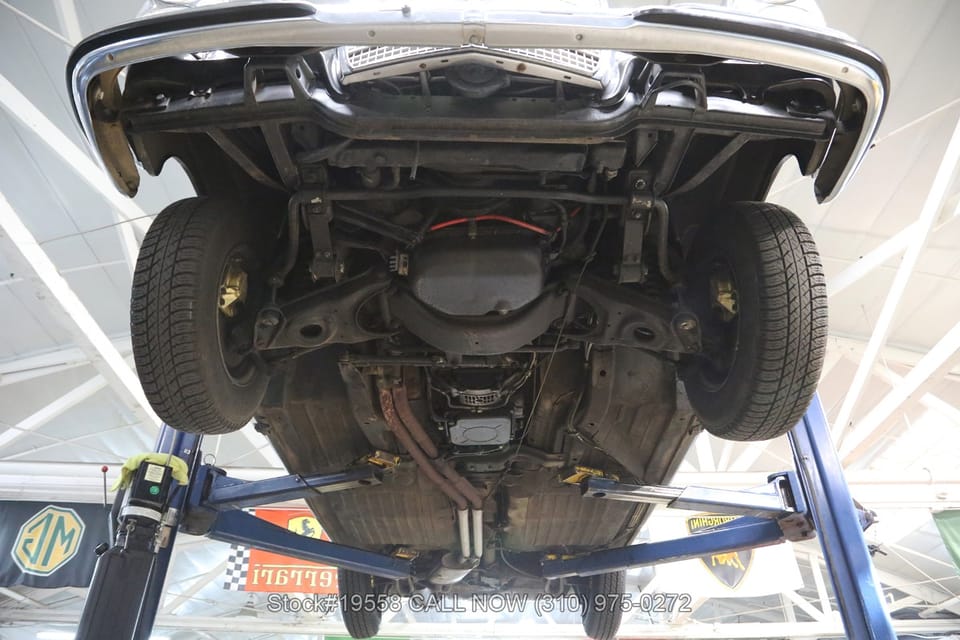
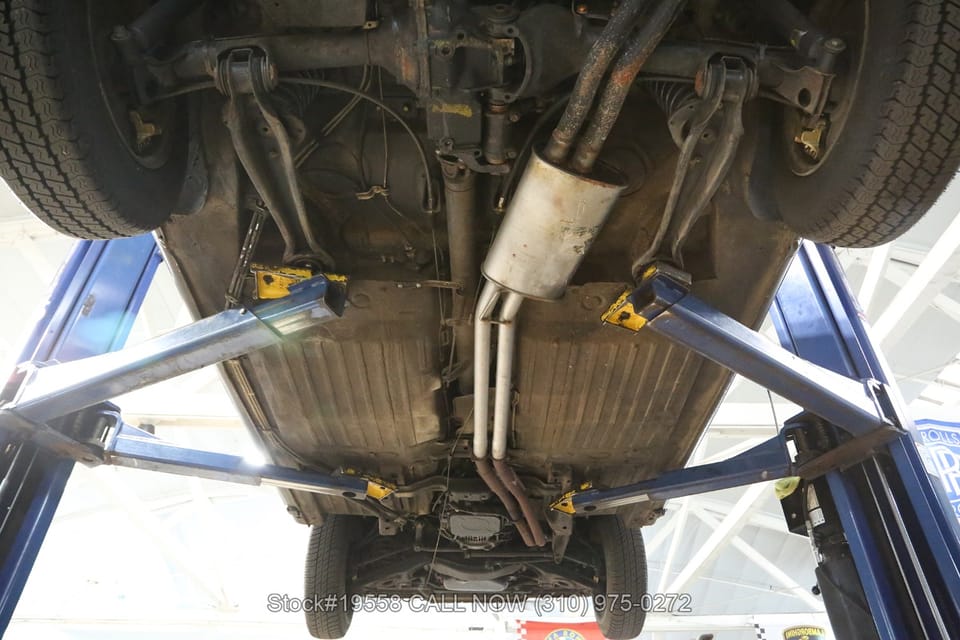
Frame rails, crossmembers and spring perches. The structural heart of the car, and the reason a lift inspection is worth paying for. The front frame rails and jacking areas, the front crossmember and the rear spring perches all rot, and none is a cosmetic fix — perch and rail repairs are fabrication work, priced per car, and quickly exceed the value of a cheap example. It is also the area sellers' photos most often avoid: in 16 of the 37 listings we examined, there was not one photograph of the underside. Learn to read the coating while you are under there. Factory underseal is a uniform PVC coating with brush-sealed seams and consistent edges, and after fifty years it looks honestly patchy — thin at the edges, chipped where stones hit, dirty. A uniform coat of fresh black stone-chip blown over everything — seams, jacking points, brake pipes, the lot — is a cover-up until the seller proves otherwise, because nobody re-underseals a sound underside the week before a sale for your benefit.
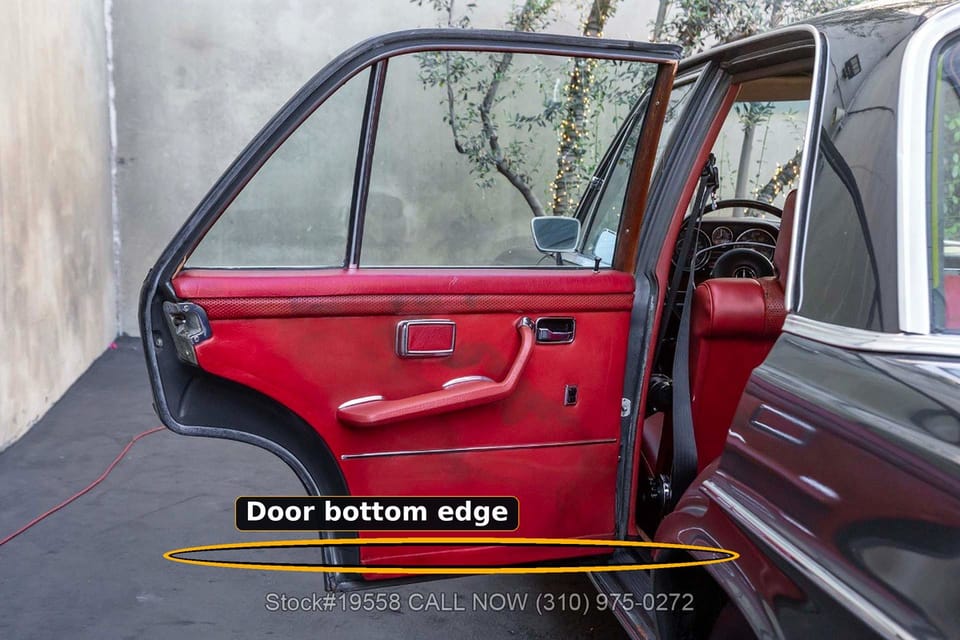
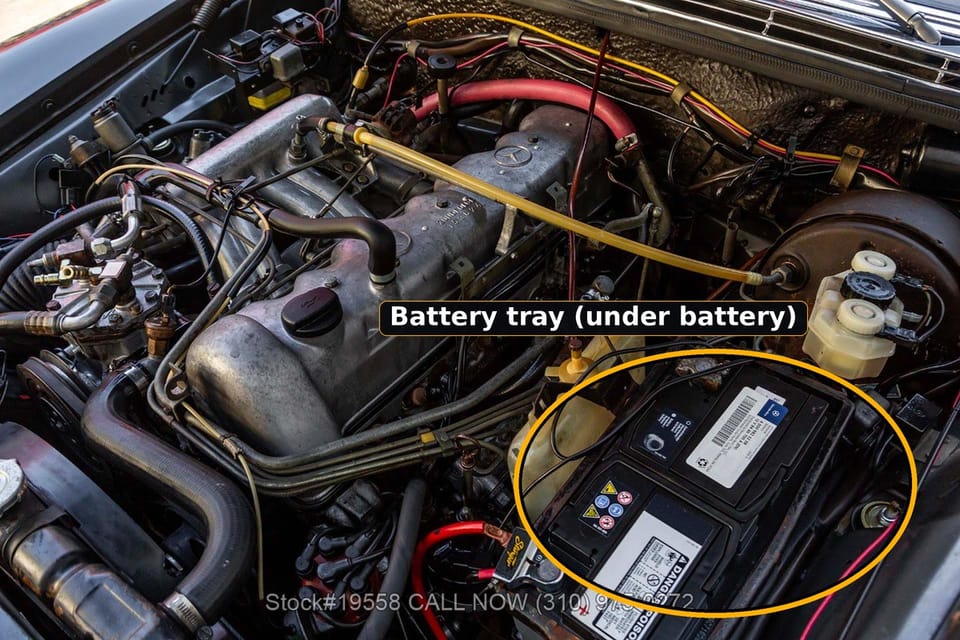
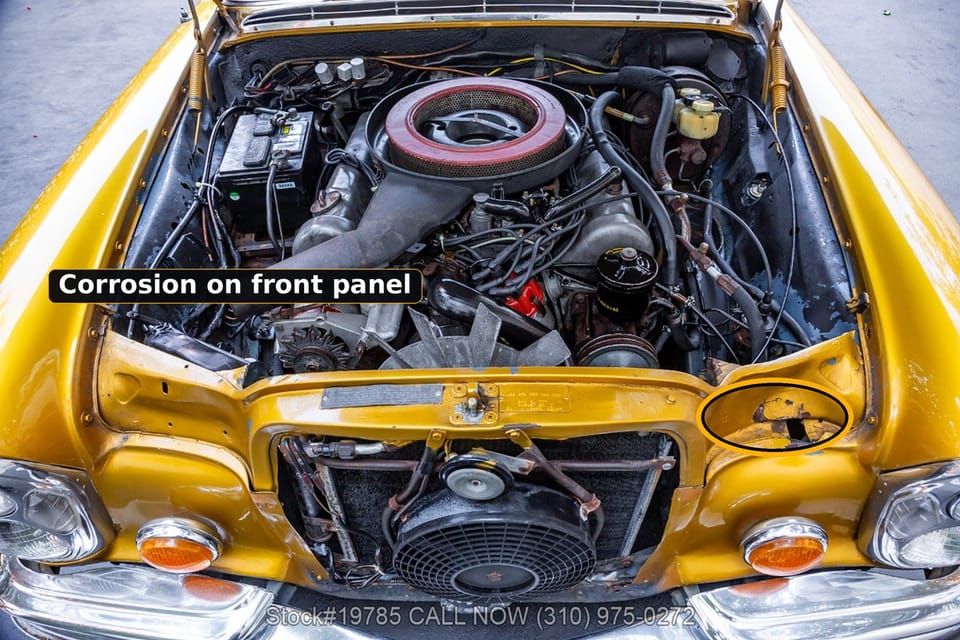
The smaller traps. Door bottoms (the drain holes block and the doors fill with water — run a fingertip along the bottom edge of every door and feel for bubbling under the paint, then check the drain slots are clear), the battery tray and firewall around it, headlamp bowls, the bottoms of the front wings behind the wheels, and the windshield surround. None alone kills a car, but together they show how the car has lived — and door and wing repairs add up fast. The battery tray deserves its own minute: it rots from the top down, underneath the battery, so it is invisible with the battery in place — and the acid track runs down the firewall behind it. Lift the battery out, or at minimum rock it and look at the tray edges and the firewall below with a torch. A new tray welded in is not big money; the firewall and inner-wing damage underneath it can be.
Front suspension, steering and the rear axle
The W108 front suspension is a double-wishbone design built around kingpins — a pre-war layout Mercedes kept because it is immensely strong, maintained with a grease gun. There are three grease nipples per side — the kingpin itself and its upper and lower joints — plus the control-arm pivots, and they want attention roughly every 3,000 miles. Skip it for years and the kingpins and threaded link pins wear, giving vague steering, knocks over bumps and uneven tire wear. But never condemn a kingpin dry. Old grease hardens inside the passages until fresh grease won't pass at all, and a joint that rocks like a worn one can come back into specification once it is actually lubricated — warm the joint if the gun won't push grease through, grease it properly, and only then rock the top of each front wheel in and out and judge the play. A specialist kingpin rebuild is roughly $800–1,500 a side — the price is in the machining, pressing new bushes into the steering knuckles and reaming them to fit — so the grease-first check is worth real money. Check the front subframe mounts too — the rubber perishes and makes the front end feel loose; the mount kit itself is about $200, and a set fitted runs $600–1,100.
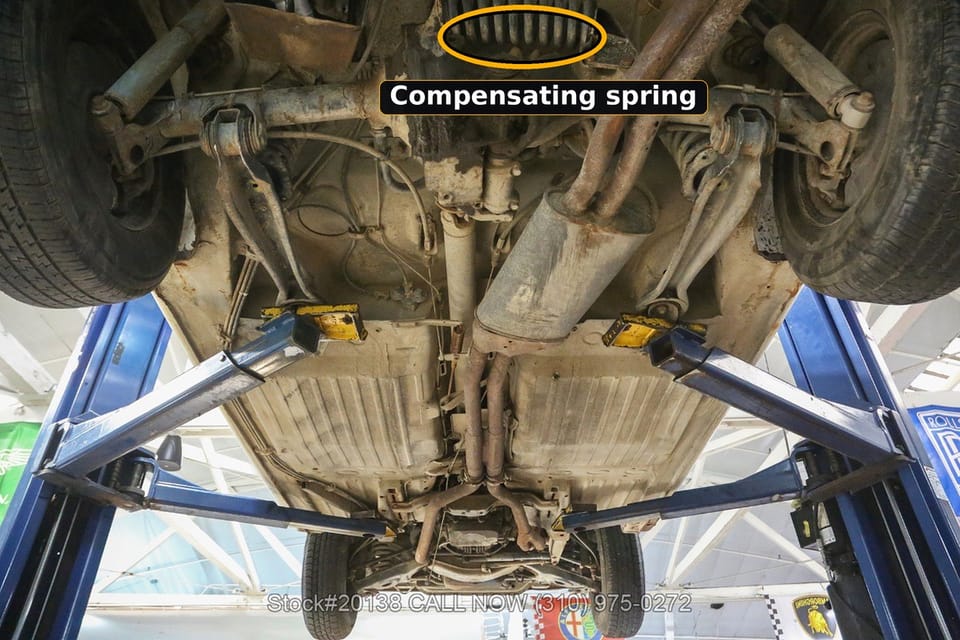
At the rear, the swing axle uses coil springs plus a hydropneumatic compensating spring in place of a transverse coil spring over the differential. The compensator — a ZF/Boge unit — is self-pumping: axle movement works it against a gas cushion, so it restores ride height under load with no pump and no electrics. That gives you a proper functional test: load the trunk heavily, drive around the block, and a live compensator pumps the car back to level; a dead one leaves it sitting down. Read static stance carefully before blaming it, though. A tail-down car with normal rear-wheel camber is usually tired road springs; sag with the rear wheels tipping noticeably in at the top points at the compensator circuit. When a compensator fails, replacements are expensive — an overhauled unit from a European specialist runs around €1,700 before fitting — which is why many cars have been converted to a plain coil spring where the ribbed unit should sit. The conversion works, but it gives up the self-levelling, and converted cars often sit oddly — the commonly supplied conversion spring is the heavy-duty one, so an unloaded converted car frequently sits tail-high, sometimes unevenly side to side. A car sitting noticeably wrong at the back, in either direction, is telling you something.
Brakes are discs all round — advanced for 1965 — and the parts are cheap. What isn't cheap is undoing twenty years of sitting: seized calipers, perished hoses and a tired master cylinder are the standard list, $800–2,000 for a full hydraulic refresh with labor. Judge the discs, not just the pedal: a car that has stood wears a rust band and a lip on every disc, and the handbrake is a separate drum inside the rear disc hat, so a handbrake that barely holds is its own small job, not a caliper verdict.
Interior and trim
The cabin is where a good W108 feels a class above everything else of its era — and where costs hide in plain sight.
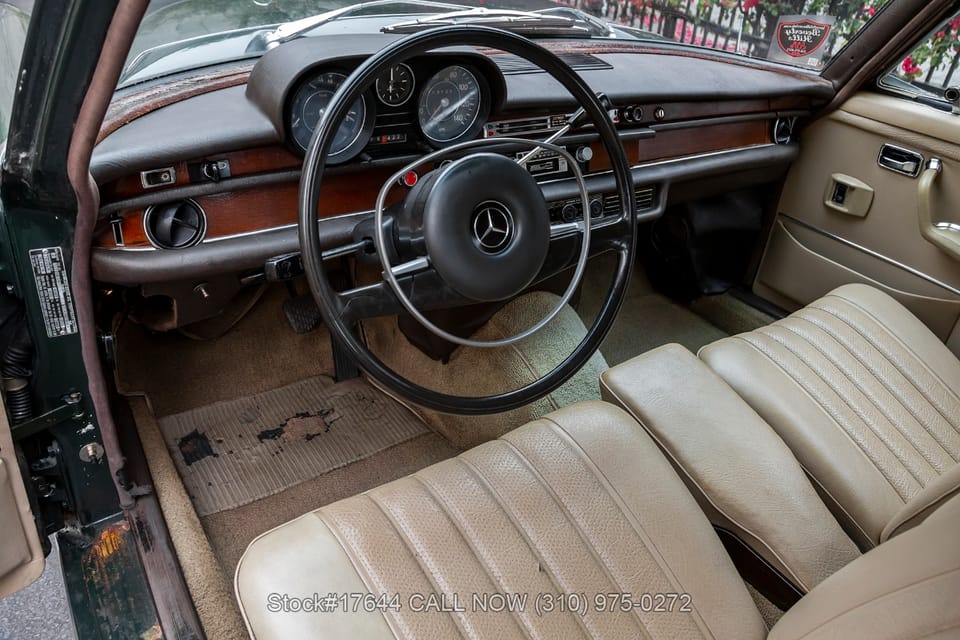
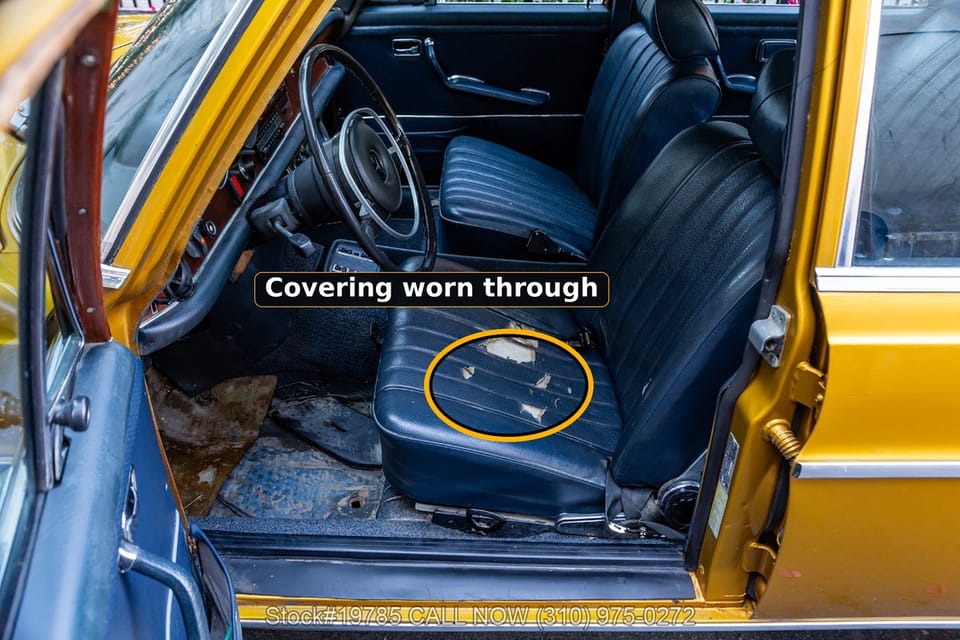
Seats. Most US cars have MB-Tex vinyl, which is nearly immortal; leather was the expensive option and cracks with age and sun. Under either covering, the pads are horsehair (rubberised coconut fibre), and they crumble — the tell-tale is greenish dust under the seats and a sitting position like a hammock. Sit in the driver's seat, not just the passenger's: the driver's cushion goes first, the cover wears through at the entry bolster, and once you can feel the spring frame through the pad the job is pads and covering together. Re-padding a front seat (pads and labour) is roughly $300–600, and more if the spring box needs welding; a professional full leather retrim runs into five figures, so a good original interior is worth real money. Seat condition showed up as a cost item in 22 of the 37 cars we photo-checked.
Wood. The dashboard and window-frame veneer cracks and lifts, lacquer first, then the veneer. One piece of good news: in our photo sample the wood was the best-preserved part of most interiors — only a handful of cars showed serious damage. Professional refinishing of the full set is $1,500–3,500 and genuinely specialist work; check the window-frame pieces as carefully as the dash, as they are thinner and crack first. Read the finish, not just the wood: lacquer that has gone milky or crazed is a refinish; veneer that has lifted, bubbled or been sanded through at the edges is a reveneer, and the two jobs are priced very differently. Mismatched tone between the dash strip and the door cappings means one of them has already been done.
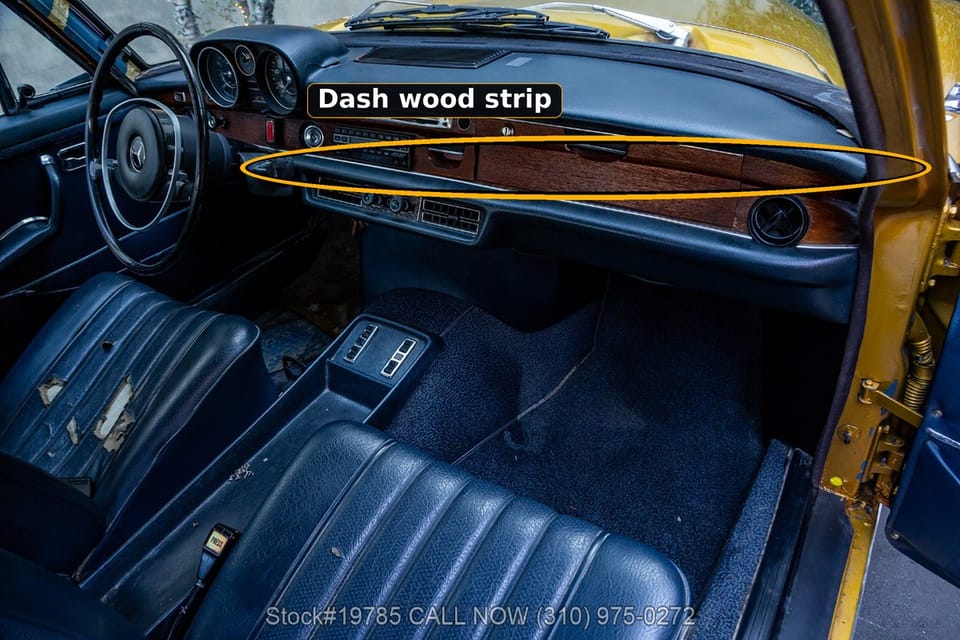
The heater. Test it on every viewing, even in July. The blower motor lives behind the dashboard, and replacing it is a 10–20 hour dashboard-out job — $1,500–3,500 all-in at shop rates, on a part that costs about $350. A W108 with a dead blower is a car with a four-figure repair already scheduled.
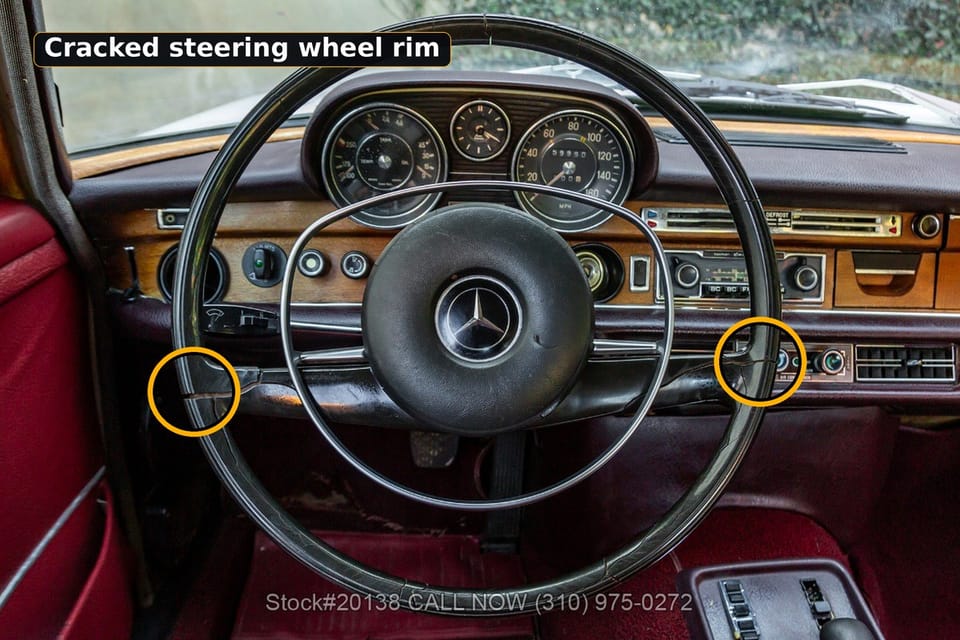
The rest. Window regulators wear and early switches fail; the big padded steering wheels crack around the rim — cosmetic, but very visible; and chrome, inside and out, pits — re-plating a full set of W108 brightwork is a serious bill. In our sample, chrome pitting showed in roughly half the cars.
Electrics
Fifty-year-old wiring fails at the connections, not in the middle of the wires. Dim lights, intermittent accessories and a wandering fuel gauge are almost always earth (ground) points — cheap to fix, tedious to find. The bigger-ticket items are the D-Jetronic components on the V8s, and electric window motors and switches. A car where everything electrical works — windows, blower on all speeds, washers, clock, radio — has usually been used and maintained, which is the best sign there is.
How to inspect one
Allow at least an hour, bring a torch, a magnet wrapped in cloth and a screwdriver for prodding (with the seller's permission). If the car passes you, pay for a lift inspection before money changes hands — on a W108 it is the best $150 you will ever spend.
- Start with the paperwork. Match the VIN on the title to the plate in the engine bay and the stamping on the frame. Ask for the data card and any invoices — a thick history file is worth thousands. Check the engine number against the badge: a 3.5's engine number begins 116.980, a US 4.5's 117.98, whatever the boot lid says.
- Cold start. Insist the engine is cold when you arrive. An injected car should start at once and settle; watch for blue smoke (valve seals or worse) and listen for timing-chain rattle on a V8.
- The dipstick test. On an injected six, smell the engine oil for petrol — and read the level, not just the smell. Fuel in the oil means injection pump wear, and dilution raises the level: an engine whose "oil" sits above the mark, thin and petrol-smelling, is telling you the pump is passing fuel. On pumps with their own reservoir, pull the pump's dipstick too and apply the same test. Either way it is a $2,000-plus conversation.
- Under the car. Torch along both sills, prod the jacking points, check the floor seams, the front frame rails, the crossmember and the rear spring perches. Perforation in rails, perches or sills is structural. Read the underseal as you go — patchy and honest is factory; a fresh uniform black coat over everything is a question, not an answer. If the seller allows it, the sill-jack test from the rust section settles the sills in five minutes. This step decides whether you continue at all.
- Trunk. Lift the spare wheel and the mat. Look for water staining, rust in the well corners and a damp smell. Check the rear window seal while you are there.
- Floors inside. Lift all four carpets. Look for water tracks from the windshield base and heater box, and prod the pans. Wet carpets in a "dry-stored" car mean leaking seals and rust starting.
- Body and gaps. Run the magnet over the sills, arches and lower doors — filler announces itself. Check door bottoms for bubbling, the battery tray for acid damage, and panel gaps for accident history. Count the pitted chrome pieces and price them.
- Kingpins and steering. Rock each front wheel top-to-bottom for play — but treat dry play as a question, not a verdict: a kingpin starved of grease for a decade can feel worn and come back once greased. If the car otherwise stacks up, price the rebuild in ($800–1,500 a side) and let the post-grease check after purchase confirm it. On the drive, the steering should be light, accurate and free of knocks over bumps. Vagueness plus a knock is a front-end rebuild priced into the offer.
- The test drive. Fifteen minutes minimum, including a freeway stretch. The automatic should pull away in second (normal), change firmly, and engage reverse without a long pause or a thump. A six should pull cleanly to 4,000 rpm without hesitation — flat spots mean carburettors on an S, fuel system on an SE. Brake hard from speed: it should stop straight, with no judder.
- Heat, idle and electrics. Let it idle hot. Check oil pressure behaviour, temperature stability, and — whatever the weather — run the heater and blower on every speed. Work every window, the washers, lights, horn and radio. Dead blower equals dashboard-out money.
- Ride height and stance. Stand back. A W108 should sit level. A sagging rear with the wheels tipping in at the top points to the compensator circuit — load the trunk, drive around the block, and see whether it pumps itself back up; sag with normal camber is road springs, and a tail-high rear usually means a coil conversion is fitted. A sagging front points to springs or subframe mounts. Look down each flank for ripples.
- Interior last. Sit in every seat and feel for collapsed pads; look underneath for the green dust of dead horsehair. Check the window-frame wood closely. A sound, original interior is the hardest thing to recreate, so weight it heavily.
Values
Prices below come from our own listings data — the same figures behind our market prices by model page — as of November 2026. We currently track 54 W108s in the US market, 32 of them for sale. Two cautions: these are asking prices, not achieved prices, and for the rare models the sample is one or two cars, so a single exceptional (or desperate) listing moves the numbers. As a cross-check we also show the median of Bring a Trailer auction results over the last twelve months, where the model has them.
| Model | For sale now | Median asking price | Asking range | BaT median, last 12 months |
|---|---|---|---|---|
| 250S | 2 | $11,000 | $3,999–$18,000 | — |
| 250SE | 1 | $3,500 (a project) | — | — |
| 280S | 1 | $3,000 (a project) | — | $28,500 (1 sale) |
| 280SE | 10 | $25,000 | $8,200–$349,000 | $9,750 (6 sales) |
| 280SEL | 4 | $10,500 | $4,000–$17,000 | $18,375 (2 sales) |
| 280SE 3.5 | 1 | $12,500 (a project) | — | — |
| 280SE 4.5 | 11 | $20,500 | $7,500–$49,000 | $15,251 (6 sales) |
| 300SE | 2 | $12,475 | $5,000–$19,950 | $19,610 (1 sale) |
Read the table with the condition spread in mind. The 280SE range runs from $8,200 to a $349,000 outlier because the top of this market belongs to exceptional cars, while the typical honest driver changes hands in the teens and twenties — the auction median of $9,750 against a $25,000 median asking price tells you sellers ask more than the market pays. The 280SE 4.5 is the volume V8: a $20,500 median ask, with sold cars in our archive averaging about $24,300. The 3.5 is the opposite market: only one is listed as we write, at project money, while our sold archive holds a 3.5 sale at $159,500 — the gap between a project and a good one is wider than for any other model. The cheap cars at the bottom of every row share the same story: rust, storage, or both. There is no such thing as a cheap W108 that stays cheap.
Parts and ownership
The W108 is one of the best-supported Mercedes of its era: Mercedes built a third of a million of them, the factory still cares — the Mercedes-Benz Classic Center supplies a wide range of parts — and the cars share many components with the W111 coupes and W113 SLs, which keeps the specialist trade busy.
Easy: service items, filters, plugs, points, brake discs, pads and hydraulics, suspension wear parts, kingpin kits, water pumps (later sixes), exhaust systems in standard form, glass rubbers and most seals. Order today, fit this weekend, at prices close to modern-car money.
Harder and dearer: the mechanical injection pump (rebuild $2,000–3,500, and the car's value hinges on it), Zenith carburettor work done properly, D-Jetronic pressure sensors and ECUs (good used units are hunted), the rear compensating spring (overhauled units run around €1,700 from European specialists), V8 exhaust manifolds, heater blower motors (cheap part, expensive address), chrome in good order, crack-free wood sets, and early 300SE engine parts. A quality repaint starts around $10,000 — which is why the mantra of this guide is to buy the body and interior, and fix the mechanics.
Running costs. In our photo checks, 16 of the 37 cars had engine bays that clearly needed work — oil leaks, surface corrosion, tired hoses and belts — and that is the pattern: the sixes are the toughest engines Mercedes made in the period, and what stops them is almost always the injection pump, the carburettors or the ignition, not the engine itself. A sorted W108 is a realistic regular-use classic: fuel consumption in the mid-teens mpg, servicing any good independent Mercedes specialist can handle, and insurance in line with other cars of the value. The budget line that catches new owners is the first year — catching up deferred maintenance on a running car honestly costs $2,000–5,000 before you improve anything, and recommissioning a car that has sat for years runs $4,000–8,000 at a shop. Cars that have sat need the fuel system cleaned end to end (modern ethanol fuel attacks old rubber and leaves varnish in tanks), every brake component inspected, and all fluids and seals renewed. Buy a car that has been in regular use over one that has been asleep, even at a higher price.
Which one to buy
- The all-rounder: 280SE. Injected, quick enough, the best parts support and the deepest market to buy from and sell into. If you want one W108 to drive and enjoy, this is it.
- The value buy: 280S. Mechanically the same car with carburettors. A sorted 280S with rebuilt Zeniths is the cheapest route into a good W108 — just make sure the carburettor bill has already been paid by someone else.
- The cruiser: 280SE 4.5. If your driving is American — distance, air conditioning, torque — the 4.5 is the pick, and at current medians it is no more expensive than a good 280SE. The 280SEL 4.5 adds rear legroom for the same driving experience.
- The collector car: 280SE 3.5. The flagship, priced like one when it is right. Verify originality ruthlessly (engine number, data card), because a wrong-engined or rusty 3.5 is worth a fraction of a correct car.
- The connoisseur's car: 300SE. Rarest, most characterful six, and priced gently in today's market because buyers overlook it. Parts for the M189 demand patience. A good one is a connoisseur's bargain.
- The family car: 280SEL. The long wheelbase turns the rear seat into a genuinely comfortable place. Rarer than the SE, usually cheaper than it should be.
And the rule that overrides all of the above: buy the least rusty car you can find, in the specification you can live with. Engines, gearboxes, brakes and blower motors are all fixable at prices you can plan for. A rotten shell costs more to put right than the finished car will be worth — and it is the one thing about a W108 that can never be made original again.
See the 53 W108 cars currently listed.